EnforcementPress Release 2026-113Enforcement results
SEC Enforcement Action Totals: 348 Cases, $1.095 Billion Ordered
The SEC's fiscal 2026 enforcement results show 348 actions and $1.095 billion in relief ordered, plus new units for retail fraud and financial reporting.
Headnotes
- 348 actions: 235 standalone and 113 follow-on administrative proceedings.
- Two-thirds of standalone actions included charges against at least one individual.
- Monetary relief of $1.095 billion, made up of $752 million in disgorgement and prejudgment interest and $343 million in civil penalties.
- About $731 million was returned to more than 250,000 harmed investors.
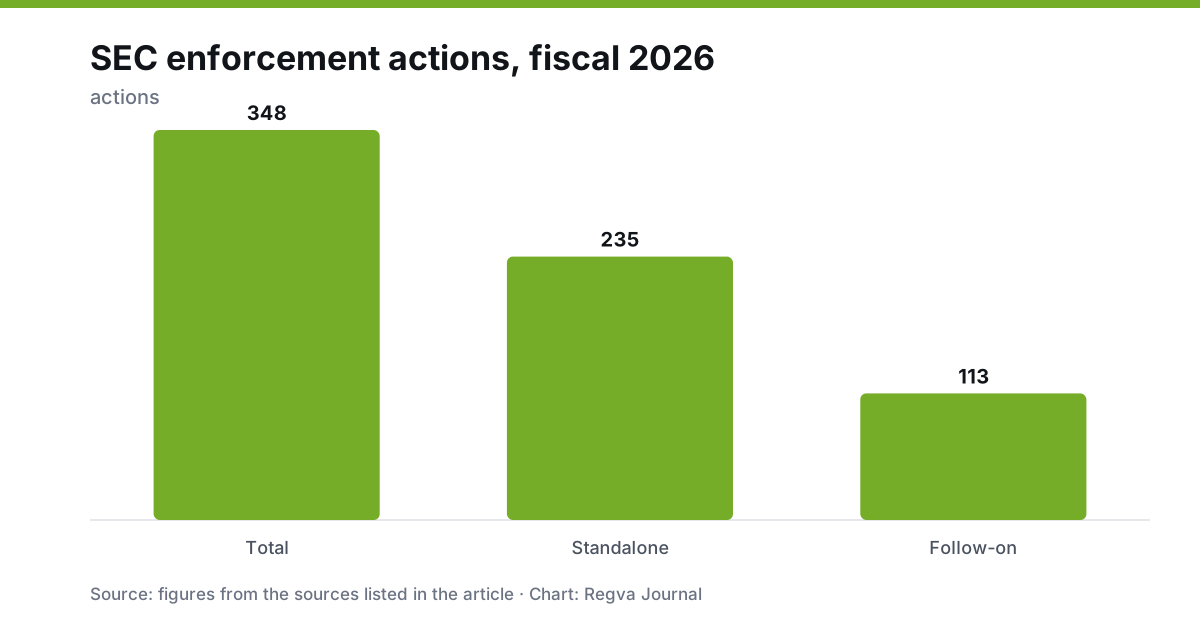
WASHINGTON — The Securities and Exchange Commission filed 348 enforcement actions in fiscal year 2026 and obtained orders for $1.095 billion in monetary relief, the agency said on Nov. 10 in its annual results announcement. The fiscal year ended Sept. 30. Each SEC enforcement action in the tally is counted in one of two ways, and the split says something about where the Division of Enforcement is spending its time.
Key takeaways
- 348 actions: 235 standalone and 113 follow-on administrative proceedings.
- Two-thirds of standalone actions included charges against at least one individual.
- Monetary relief of $1.095 billion, made up of $752 million in disgorgement and prejudgment interest and $343 million in civil penalties.
- About $731 million was returned to more than 250,000 harmed investors.
The numbers
Of the 348 actions, 235 were standalone cases. The other 113 were follow-on proceedings, which seek to bar or suspend individuals from certain securities-market activities because of criminal convictions, civil injunctions or other qualifying orders. The commission also instituted 13 trading suspensions tied to suspected manipulation involving securities of Asia-based issuers.
On money, the $1.095 billion ordered includes $752 million in disgorgement and prejudgment interest and $343 million in civil penalties. The SEC noted that $235 million of the disgorgement was deemed satisfied by a court in a separate non-SEC action. Distributions to harmed investors came to roughly $731 million.
Priorities the SEC highlighted
The announcement lists fraud, market manipulation, insider trading, gatekeeper failures and violations that compromise the integrity of disclosures and financial reporting as the focus of the year’s cases. Chairman Paul S. Atkins said that actions and financial remedies are measures of activity but “not the only or most telling” ones, and that the goal is to apply the law fairly and consistently. David Woodcock, the Division of Enforcement’s director, said the division reviewed its investigative docket and strengthened its capabilities during the year.
New units and tools
The release describes several organizational changes in fiscal 2026:
- Retail Fraud Working Group. It targets Ponzi schemes and offering frauds, impersonation scams, broker-dealer misconduct, false filings and market manipulation that affect everyday investors. The SEC said more than a dozen new investigations have already resulted.
- Financial Reporting and Accounting Unit. It combines attorneys and accountants to handle accounting and disclosure fraud and misconduct by accountants and auditors.
- Office of Super Intelligence and Analytics. The office brings data-driven tools into investigations, including anomaly detection, faster document and transcript review and improved blockchain and financial-flow analysis.
- Trial Unit reorganization. New deputy chief litigation counsels now oversee litigators across the commission’s offices.
The division also started a leadership training program for supervisors and a performance-management process in which senior officers hold bi-monthly meetings with senior leadership on investigation timelines, milestones and staffing.
What the figures suggest
The mix matters as much as the total. A sizeable share of the count is follow-on proceedings, which move quickly because they rest on an existing conviction or judgment. The standalone figure of 235 is the better gauge of new investigative work, and the SEC’s emphasis on individual charges signals that executives and promoters, not only entities, remain in the line of fire.
Issuers and advisers can also read the new units as a preview of exam and investigation themes: accounting controls, retail-facing offerings and data-assisted detection.
What to watch
The SEC said the leadership training program will continue beyond the fiscal year. The next signals will come from case filings in the months ahead, particularly any actions that trace back to the retail fraud group or the financial reporting unit.
Prepared with AI assistance from the releases cited in the margin and reviewed under our editorial policy. Not legal advice.